
SOP review services do good business fixing drafts that were never structured. The fix is cheaper in the other order: outline first, write second, pay for review last, if at all. The SOP Builder generates the outline free. Here are 7 ways to use it before any money moves.
1. Outline before you draft a single sentence
Structure is the whole product. The builder returns the sections in order, from the opening through experience, why this program, future goals and the closing, each with prompts written from the profile you gave it. A draft written into that frame rarely needs rescuing.
2. Use the word budgets as your first editor
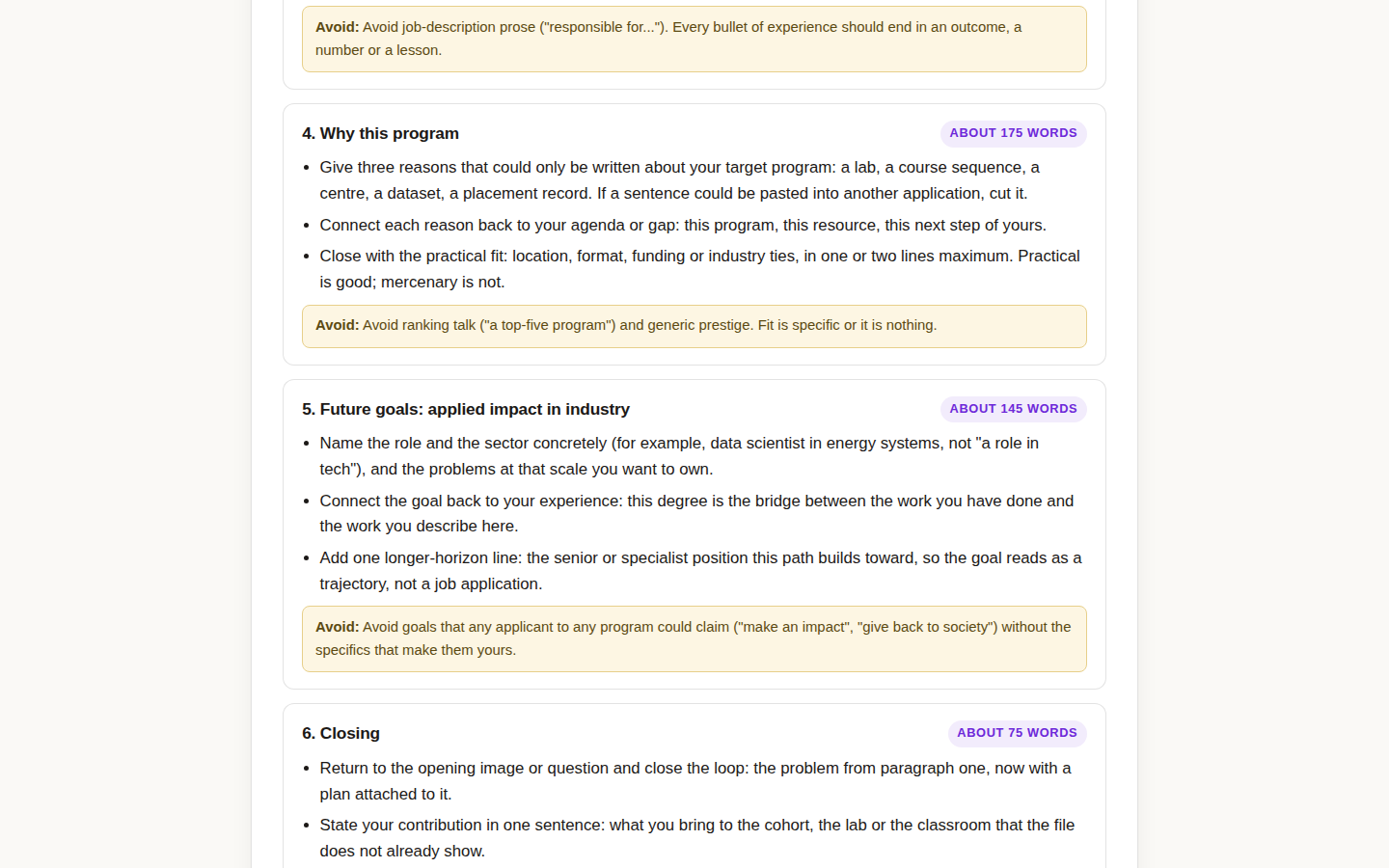
Every section carries a budget: in one real run, "Why this program" got about 175 words, "Future goals" about 145, the closing about 75. When your draft runs long, the budget tells you which section is bloated. That is the note a paid editor would give you first.
3. Read the Avoid notes before you write
Each section ends with what to avoid: job-description prose where every bullet should end in an outcome, ranking talk and generic prestige in the program section, goals any applicant could claim. They read like the margin notes on a reviewed draft, except they arrive before the draft exists.
4. Feed it your real profile, switch and all
The outline is only as honest as the inputs. Give it your actual background, your research interest (our test run used mechanical engineering moving toward renewable energy storage), your GPA and your goal, and tick the career switch box if you are switching. The prompts come back about your path, not a generic one. Our post on getting into a masters with a 3.0 GPA covers the profile side of the same problem.
5. Build one outline per program, not one per season
"Why this program" has to be written per target: a lab, a course sequence, a placement record. Two free outlines a day is enough for a pair of programs a day across a season. What admission chance calculators cannot tell you applies here too: the outline is a frame, and the specifics are yours to supply.
6. Take the outline to the review service, not the ramble
If you still want professional eyes, compare what you are buying first: our comparison of 5 SOP review services is the most-read page on this site, and editing service versus doing it yourself breaks down the honest trade. A reviewer working from a structured draft spends their time on framing and voice, not on rebuilding your sections, and that is the part actually worth paying for.
7. Download the Word document and draft inside it
The builder exports a .docx with the sections and prompts in place, or copies as plain text. Draft inside the document and the structure survives your writing sessions. When you are done, check the draft against the 10 mistakes that get applications ignored.
The short version of the tool is in our explainer post. Or go straight in: build your outline free, and let the review services compete for a draft that is already standing up.