
Every weak statement of purpose fails in one of ten familiar ways. The useful question is not the list, it is the sorting: some of these mistakes are surface damage that an sop editing service fixes in one pass, and some are structural, which means no editor can save them and the draft has to be rewritten. Paying for the wrong kind of help is how applicants waste both money and a cycle.
The 10 mistakes, kept short
1. Opening with childhood passion; everyone's childhood was passionate. 2. No program specifics; if the statement fits ten universities, it fits none. 3. Listing the resume in prose; the CV already exists. 4. Writing 1,500 words when they asked for 500; the limit is a test. 5. Flattery, "your prestigious university"; they know. 6. Excuses for the GPA without evidence of change. 7. Name dropping professors you have never read. 8. Cliches: "broaden my horizons", "world class faculty", "cutting edge". 9. No future plan; where does this degree take you? 10. Submitting the first draft; every good statement is draft four or later. Mistakes 2 and 9 sink the most applications. Fix those two and you are ahead of half the pool.
What editing actually fixes
An editor earns the fee on mistakes 3, 4, 5 and 8. Cutting CV prose down to the two experiences that matter, enforcing the word limit, deleting flattery, and hunting cliches are mechanical skills, and a fresh reader spots all four faster than the writer ever will. Mistake 1 is half fixable: an editor can flag the childhood opening and tighten whatever replaces it, but the replacement story has to come from your life. Mistake 10 is a process, not a pass; a good service builds revision rounds in, which is editing used properly.
What only a rewrite fixes
Mistakes 2, 6, 7 and 9 cannot be edited into existence. Program specifics require you to research the labs, courses and faculty and write new material. A GPA explanation without evidence of change is an argument problem, not a grammar problem. Name dropping collapses the moment a reader checks whether you have actually read the work. A missing future plan is a missing section. If your draft carries two or more of these four, do not buy editing yet. Restructure first, ideally against an outline, then edit the stronger draft.

What it costs, from our own comparison
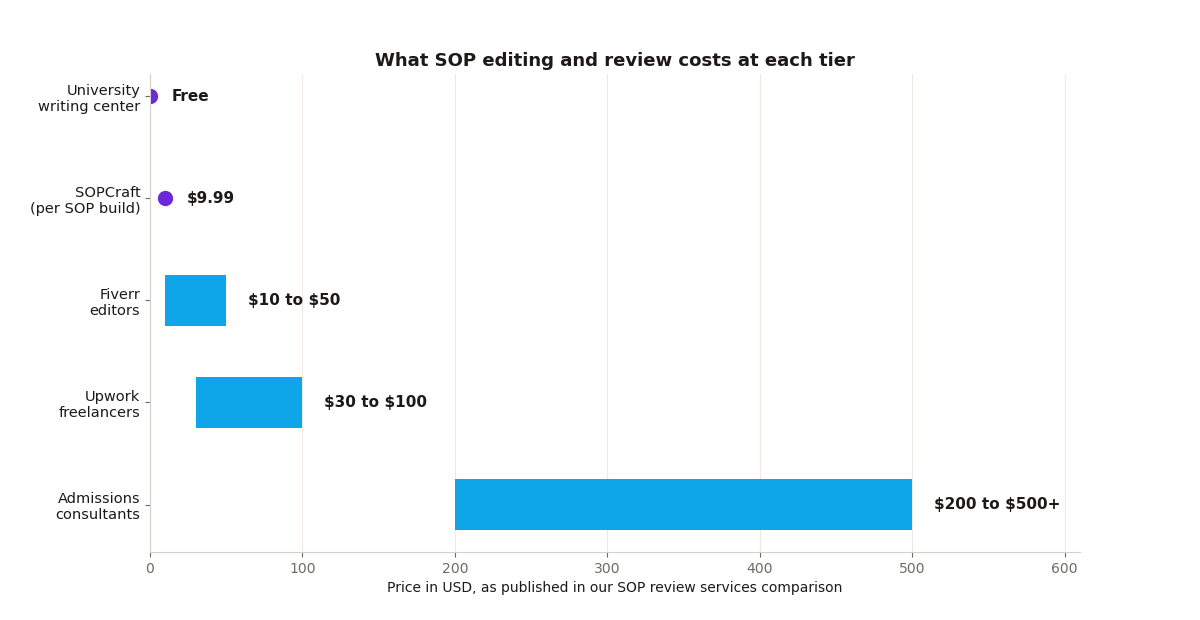
Our published comparison puts the tiers like this: a university writing center is free and fixes sentences. SOPCraft builds a tailored document for $9.99 per SOP build. Fiverr editors run $10 to $50 and mostly proofread. Upwork freelancers run $30 to $100 with wildly variable quality. Admissions consultants run $200 to $500 and up per school, which makes sense for MBA and funded PhD stakes and little sense elsewhere. Match the spend to the stakes and to the mistake type: surface problems buy the cheaper tiers, structural problems buy a rewrite first, whatever it costs.
A triage you can run tonight
Print the draft and mark it in two colors. Mark every sentence that could appear in a stranger's statement: the flattery, the cliches, the childhood opening, the CV prose. That is your editing pile, and it is usually a quarter of the document. Then mark what is missing rather than weak: a program specific paragraph, a future plan, one piece of evidence that your grades changed or your skills did. Missing material cannot be marked on the page, so write the list on the back. If the back of the page has more on it than the front, you are in rewrite territory, whatever your budget.
Sequence matters as much as sorting. Rewrite the structural gaps first, while changes are cheap; a new fit paragraph rewrites the opening and the closing around it, so editing sentences before that paragraph exists wastes the editing fee on text that will not survive. Do the surface pass last, in the final week, when the document has stopped moving. Applicants who reverse the order, polish first, restructure second, pay twice and ship a draft that reads smooth and says little. Applicants who sort first usually discover that the expensive tier was never the one they needed.
Sort your draft before you spend
Run your draft through the free SOP Builder outline and compare section by section: any section the outline expects that your draft lacks is a rewrite item, and everything present but flabby is an editing item. Our full comparison of 5 SOP review services has the per service detail, and editing service vs doing it yourself argues the other side fairly. Sources: EducationUSA